
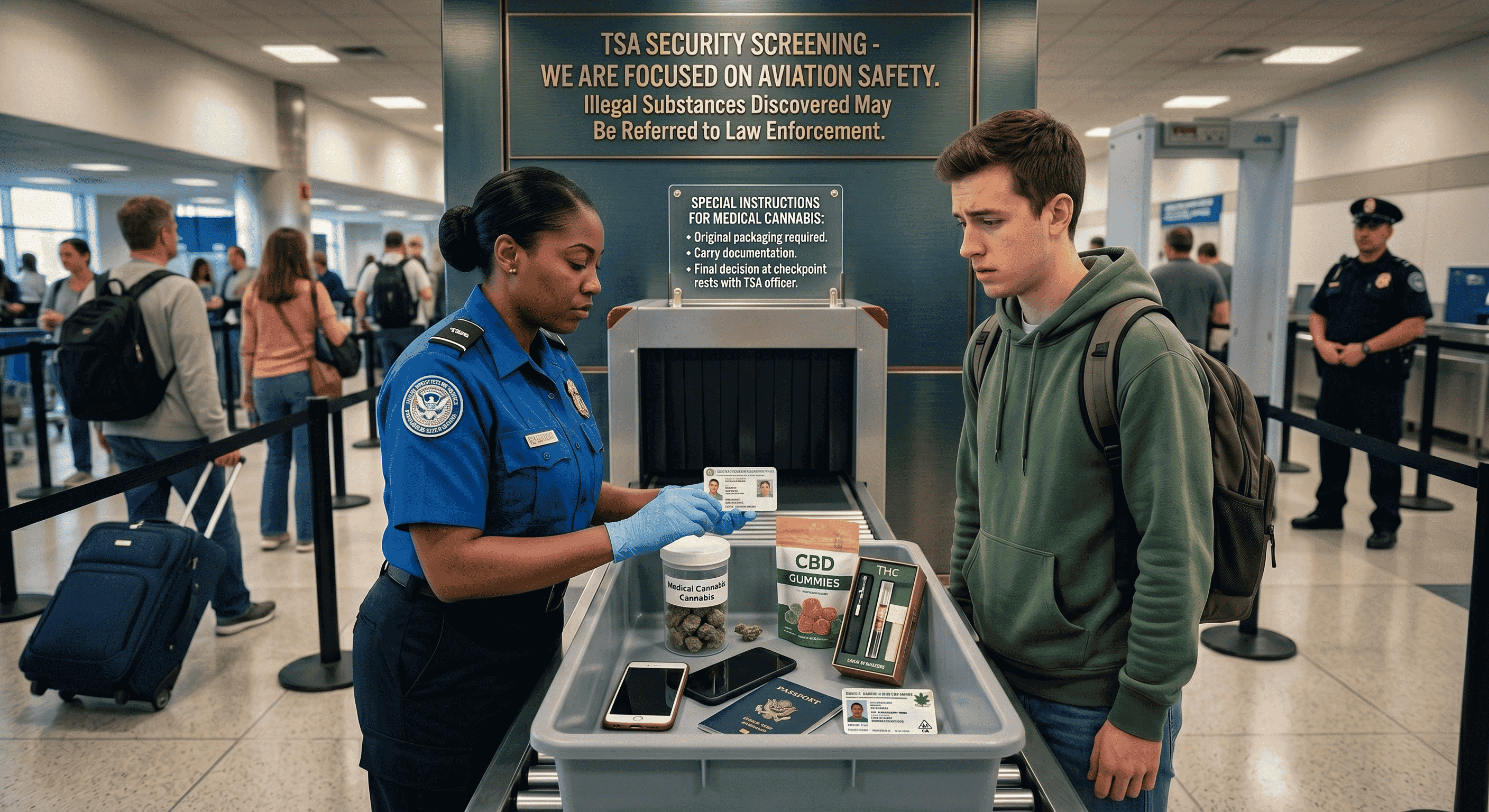
Packing cannabis for a flight can feel confusing because the rules do not work like normal travel rules. A product may be legal where you bought it, but that does not always mean it is safe to take through airport security.
This is why travelers are asking more questions in 2026:
- Can you fly with medical marijuana?
- Is CBD allowed through TSA?
- Are THC gummies treated like food?
- Can a vape cartridge go in a carry-on bag?
The answer depends on the product. TSA says its screening process is focused on aviation safety, not drug searches. However, if an illegal substance is found during screening, TSA may refer the matter to a law-enforcement officer. TSA also says the final decision at the checkpoint rests with the TSA officer.
TSA Cannabis Rules: What Travelers Should Know First
TSA is not mainly looking for marijuana. Its job is to protect aviation security by screening for dangerous items, weapons, explosives, and other threats.
But cannabis can still become an issue if it appears during screening. TSA’s own medical marijuana page says officers do not search for illegal drugs, but illegal substances or evidence of criminal activity discovered during screening are referred to a law-enforcement officer.
So the key point is simple: TSA may not be looking for cannabis, but cannabis can still cause trouble if it is found.
Medical Marijuana vs. Recreational Weed
Medical marijuana and recreational marijuana are not treated the same way when flying.
|
Category |
Medical Marijuana |
Recreational Weed |
|
TSA listing |
Listed with special instructions |
Not safely allowed as a general travel item |
|
Purpose |
Used under a medical program or doctor guidance |
Used for adult personal use |
|
Examples |
Medical cannabis, FDA-approved cannabis medicine |
Flower, THC gummies, THC oils, recreational cartridges |
|
Documents |
Medical card, prescription label, or original packaging may help |
Usually does not protect the traveler |
|
Main concern |
Rules can still vary by location and airline |
Higher chance of airport problems |
|
Best approach |
Carry proof and check rules before flying |
Do not pack it for air travel |
In 2026, the Justice Department announced that FDA-approved marijuana products and state-licensed medical marijuana products were placed in Schedule III. However, this does not make all cannabis products legal to fly with.
Can You Put Medical Marijuana in a Carry-On or Checked Bag?
TSA lists medical marijuana as allowed in both carry-on and checked bags, but only with special instructions. That means passengers should treat it carefully and not pack it like an ordinary item.
If you are traveling with medical cannabis, keep it in original packaging. Carry your medical marijuana card, prescription label, doctor’s recommendation, or state medical cannabis paperwork.
A carry-on bag may be better if you need access to the product, but it will go through checkpoint screening. A checked bag may feel more private, but checked luggage is also screened.
Can You Bring CBD Oil or CBD Gummies Through TSA?
CBD may be allowed if it is hemp-derived and stays within the legal THC limit. The important number is 0.3% THC on a dry-weight basis.
For CBD oil, tinctures, creams, or gels in a carry-on bag, TSA’s liquid rule applies. Containers should generally be 3.4 ounces / 100 milliliters or less and fit in a quart-sized liquids bag.
CBD gummies and capsules are usually easier to pack than liquids, but labels still matter. Keep them in original packaging so the THC content is clear.
Are Edibles Allowed Through TSA?
CBD edibles are usually lower risk if they are hemp-derived and contain no more than 0.3% THC.
THC edibles are different. Gummies, chocolates, cookies, brownies, capsules, and infused snacks may look like normal food, but if they contain THC, they may be treated as cannabis products.
Medical edibles may be safer to explain if they are clearly labeled and supported by medical documentation. Recreational THC edibles are risky, even if they were purchased legally.
Can You Fly With a THC Vape Cartridge?
A THC vape cartridge is risky because it involves two separate rules: cannabis rules and battery safety rules.
The FAA says battery-powered vape devices must be carried on your person or in carry-on baggage. They are not allowed in checked bags because lithium batteries can create fire risks.
But this battery rule does not make THC legal. A vape pen may be allowed as a device, while the THC cartridge can still create a legal issue.
Also, passengers should not use or charge vape devices during a flight. The FAA warns that electronic smoking devices are restricted because of battery fire and heat risks.
What If TSA Finds Cannabis During Screening?
If cannabis is found during screening, TSA may call airport police or another law-enforcement officer.
What happens after that depends on the airport, the product, the amount, the location, and the rules being applied. Some travelers may be asked to throw the product away. Others could face questioning, confiscation, fines, or other consequences.
This is one of the biggest reasons cannabis travel is unpredictable: the same product may be handled differently in different airports.
Why Airport and Airline Rules Matter
TSA is only one part of the travel process. Airports and airlines can also have their own rules.
For example, LAX says Los Angeles Airport Police do not have jurisdiction to arrest people who comply with California marijuana law, but it also warns that TSA screening stations are under federal jurisdiction and marijuana laws vary by state.
Airlines may also restrict cannabis-related products in their baggage policies. Before flying, check your airline’s rules for cannabis, CBD, vapes, batteries, and medical items.
Domestic Flights vs. International Flights
Domestic cannabis travel is complicated. International cannabis travel is much more serious.
|
Travel Situation |
What to Know |
|
Domestic flight |
Rules may depend on TSA, airport policy, airline rules, and state law. |
|
Layover |
A connecting airport may have different rules from your departure city. |
|
Medical card |
It may help explain the product, but it does not guarantee approval. |
|
CBD product |
Lower risk if hemp-derived and clearly labeled, but rules can still vary. |
|
International flight |
Much higher risk because customs and border laws apply. |
|
Best choice |
Avoid carrying cannabis internationally unless you have clear legal authorization. |
U.S. Customs and Border Protection warns that marijuana remains illegal under federal border rules, including importation and exportation.
Smart Packing Checklist for Medical Marijuana or CBD
Use this checklist before putting any cannabis-related product in your bag:
- Check TSA’s current “What Can I Bring?” page.
- Check your airline’s baggage policy.
- Review rules for your departure, layover, and arrival airports.
- Keep medical cannabis in original packaging.
- Carry a medical card, prescription label, or doctor’s note.
- Make sure CBD products show no more than 0.3% THC.
- Keep CBD liquids within TSA’s 3.4-ounce / 100-milliliter carry-on limit.
- Pack vape devices only in carry-on bags, not checked bags.
- Do not use or charge vapes on the aircraft.
- Avoid loose flower, homemade edibles, and unlabeled products.
- Do not carry cannabis across international borders without clear legal permission.
Should You Pack Cannabis for a Flight?
The safest answer is: avoid flying with recreational weed.
Medical marijuana may be allowed in limited situations, and CBD may be lower risk if it meets the hemp THC limit. But airport screening, airline rules, destination laws, and border restrictions can still create problems.
Before you fly, check every rule that applies to your trip. If the product is unlabeled, recreational, homemade, high-THC, or legally unclear, leaving it at home is the safer choice.